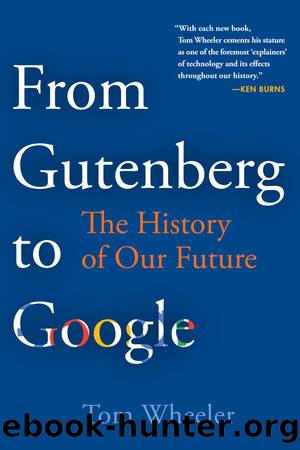
From Gutenberg to Google: The History of Our Future by Tom Wheeler
Author:Tom Wheeler
Language: eng
Format: azw3
Tags: Technology & Engineering, Networking, Science, Computers, Digital, Electronics, History
ISBN: 9780815735328
Publisher: Brookings Institution Press
Published: 2019-12-15T03:00:00+00:00
Competition and Innovation
In his 1910 report to stockholders Theodore Vail expounded on his vision: a âuniversal wire systemâ for the âelectronic transmission of intelligence.â33 He was prescient in the synergy between universality and the electronic transmission of intelligence; the analog phone network would become the universal gateway to early digital activity. He was less insightful about the impediment to such innovation that his monopoly created.
Vailâs success in transferring AT&Tâs focus away from a competitive marketplace had the effect of creating a sclerosis that hardened the network against change. While competition traditionally drives innovation, the company Vail created had succeeded in eliminating competition and thus could innovate (or not) at its own pace. The universality of the network Vail created may have become the threshold enabler of the information age. Yet that innovation would not occur without a fight, as the monopolyâs antibodies fought against the threat of disruptive innovation.
Under Vail, innovation was to be embraced but controlled. Vail, who had watched as Jay Gould used Edisonâs technology to manipulate the activities of Western Union, appreciated how new technology could negatively affect an established business. He saw a means of mitigating such a threat if the company became a technology leader itself. He began a process of expansive technology development that looked into the needs of the future, but on Bellâs terms.34
In 1925, AT&T created Bell Laboratories, which ultimately became home to arguably more IQ per square foot than any other place on the planet. Bell Labs engineers originated ideas as important as Claude Shannonâs in âA Mathematical Theory of Communication,â which envisioned information as a physical quantity to be manipulated. Scientific American called it âthe Magna Carta of the information age.â35 Bell Labs was the progenitor of the essential components to fulfill Shannonâs thesis, including the transistor, magnetic storage, and early computer languages.
AT&T became a frenetic propagator of innovation, but a sluggish adopter. While its leaders understood that the nature of networks must ultimately evolve, the first purpose of the corporation was to preserve the market position of the present network. One example of this policy at work was the development of magnetic storage. In the early 1930s a Bell Labs engineer, Clarence Hickman, developed the first answering machine by developing magnetic tape that would record sounds. It was a discovery about the magnetic storage of information with implications far beyond recording a missed phone message. AT&T ordered Bell Labs to cancel Hickmanâs research because management worried that if the public had the ability to leave a message people would place fewer phone calls.36
The ultimate tool to exploit the symbiotic relationship between the government and the phone company was a federal rule (actually an FCC-approved tariff describing rates and services) that gave the AT&T monopoly total control over anything that attached to the network. The company used the full force of the federal government to prohibit the use of any âequipment, apparatus, circuit or device not furnished by the telephone company.â37 In a fit of public relations inspiration, such non-Bell devices were labeled âforeign attachments,â or sometimes âalien attachments.
Download
This site does not store any files on its server. We only index and link to content provided by other sites. Please contact the content providers to delete copyright contents if any and email us, we'll remove relevant links or contents immediately.
The Mikado Method by Ola Ellnestam Daniel Brolund(27118)
Hello! Python by Anthony Briggs(25970)
Secrets of the JavaScript Ninja by John Resig Bear Bibeault(25307)
Kotlin in Action by Dmitry Jemerov(24413)
The Well-Grounded Java Developer by Benjamin J. Evans Martijn Verburg(23609)
Dependency Injection in .NET by Mark Seemann(23326)
OCA Java SE 8 Programmer I Certification Guide by Mala Gupta(21963)
Algorithms of the Intelligent Web by Haralambos Marmanis;Dmitry Babenko(20867)
Grails in Action by Glen Smith Peter Ledbrook(19883)
Adobe Camera Raw For Digital Photographers Only by Rob Sheppard(17080)
Sass and Compass in Action by Wynn Netherland Nathan Weizenbaum Chris Eppstein Brandon Mathis(16847)
Secrets of the JavaScript Ninja by John Resig & Bear Bibeault(14472)
Test-Driven iOS Development with Swift 4 by Dominik Hauser(12595)
Jquery UI in Action : Master the concepts Of Jquery UI: A Step By Step Approach by ANMOL GOYAL(11876)
A Developer's Guide to Building Resilient Cloud Applications with Azure by Hamida Rebai Trabelsi(10656)
Hit Refresh by Satya Nadella(9246)
The Kubernetes Operator Framework Book by Michael Dame(8592)
Exploring Deepfakes by Bryan Lyon and Matt Tora(8449)
Robo-Advisor with Python by Aki Ranin(8392)
